Dog Training Tips for Aggressive Behavior: The Ultimate Guide

Discovering that your companion exhibits reactive or aggressive tendencies can be a profoundly isolating and overwhelming experience for any pet parent.
However, you are far from navigating this challenging journey alone. According to data compiled by the American Veterinary Medical Association (AVMA), an estimated 4.5 million dog bites occur annually in the United States alone.
While these numbers highlight a significant public safety concern, animal behaviorists emphasize that aggression is not a permanent personality flaw, but rather a severe form of canine communication driven by underlying distress.
By implementing the right positive-reinforcement dog training tips for aggressive behavior , you can systematically decode your dog’s triggers, de-escalate volatile situations, and rebuild a foundation of mutual trust and safety within your household.
1. Decoding the Root Causes: The “Why” Behind the Growl
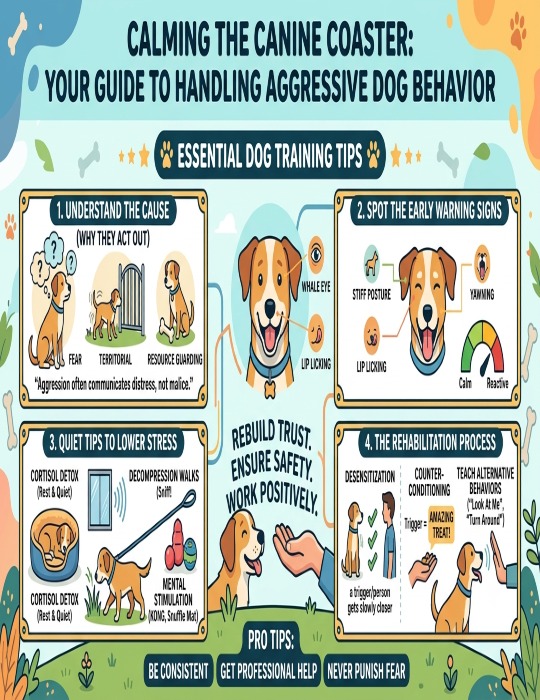
To effectively alter an undesirable behavior, we must first seek to understand the emotional driver behind it. In canine psychology, true malicious intent does not exist; instead, aggressive behaviors—such as growling, snapping, or lunging—are typically coping mechanisms for extreme emotional states.
Research indicates that fear and resource guarding are the primary catalysts for reactivity, alongside territorial instincts and undiagnosed physical pain. For example, a sudden onset of territorial snapping in an older dog is frequently traced back to osteoarthritic discomfort rather than sudden behavioral defiance.
Shifting your perspective from viewing your companion as a “bad dog” to a “distressed dog” is the critical mental pivot required to implement successful rehabilitation strategies.
Spotting the physiological warning signs early is vital to preventing an escalation into a biting incident. Dogs communicate their discomfort through highly nuanced body language long before they resort to physical defense. Experts note that over 60% of biting incidents happen because the dog’s early warning sequences were ignored or misunderstood.
The Canine Stress Continuum
- The Subtle Warnings: Look for a tense, rigid body posture, lip licking when no food is present, frequent yawning, or “whale eye” (where the white portion of the eye is visibly exposed).
- The Escalation: If these silent pleas for space are overlooked, the dog will progress to low growling, showing teeth, and finally, snapping or lunging.
2. The Invisible Culprit: Understanding “Trigger Stacking”

Many dog owners express immense frustration because they believe their pet’s aggressive outbursts occur entirely “out of nowhere.” In reality, these explosions are rarely triggered by a single isolated event, but are instead the result of a phenomenon known as trigger stacking.
This occurs when multiple, minor stressors accumulate within a short timeframe, preventing the dog’s nervous system from returning to a baseline state of calm. Think of your dog’s emotional capacity as a cup: a single stressor only fills it partially, but consecutive stressors will eventually cause the cup to overflow.
To illustrate this concept clearly, consider a typical day for a suburban pet. At 8:00 AM, a loud garbage truck rumbles past the window, raising the dog’s stress hormone (cortisol) levels by 25%. At 10:30 AM, the delivery person rings the doorbell, pushing their stress capacity to 50%.
By 1:00 PM, a stray neighborhood cat sprints across the yard, elevating their reactivity to 75%. If you attempt to brush your dog’s coat or trim their nails at 3:00 PM, they may suddenly turn and growl at you. The grooming tool did not cause the aggression; rather, it was simply the final drop that caused an already full emotional cup to spill over.
3. Quiet Management Tips for De-Escalating Tension
While you work through a behavioral modification program, managing your dog’s daily environment to prevent trigger stacking is your most powerful tool.
Lowering baseline cortisol levels is imperative because a dog operating in a constant state of fight-or-flight cannot internalize new training protocols.
Clinical data from veterinary behavior clinics reveals that intact males represent up to 70% to 76% of reported biting incidents, underscoring how hormonal influences can heighten baseline excitability.
Low-Stress Lifestyle Adjustments
- The 48-Hour Cortisol Detox: Following a highly stressful encounter or reactive explosion, provide your dog with two days of complete decompression. Eliminate busy walks and avoid home visitors to allow their adrenal system to fully reset.
- Visual and Auditory Blockers: Utilize frosted adhesive window film on low panes to obstruct the dog’s view of outdoor foot traffic, and place a white noise machine near entryways to muffle triggering neighborhood sounds. This simple adjustment is incredibly effective for visual reactors; however, if your pup still struggles whenever they step outside, mastering How to Stop a Dog From Barking at Strangers will be your vital next step.
- Decompression Sniffari Walks: Swap rigid, structured heel walking through busy neighborhoods for long-line leash walks in quiet fields or secluded trails. Allowing a dog to sniff freely naturally lowers their heart rate and triggers the release of dopamine.
- Ditch the Food Bowl: Instead of serving standard meals in a dish, utilize snuffle mats, frozen stuffed rubber toys, or scatter feeding in the grass. Engaging a dog’s olfactory senses burns mental energy and cultivates a focused, calm mindset.
4. Positive Reinforcement Behavioral Modification

True rehabilitation relies on changing your dog’s underlying emotional response to their triggers through systematic desensitization and classical counter-conditioning.
Desensitization involves exposing your dog to their trigger at a distance or intensity so low that they notice it but do not react. For instance, if your dog reacts aggressively to other canines, their “under-threshold” distance might be 50 feet away.
Counter-conditioning works in tandem with this by pairing the sight of the trigger with an exceptionally high-value reward, such as boiled chicken or liver paste. Over time, the dog’s emotional association shifts from “There is another dog, I must attack to protect myself” to “There is another dog, which means I am about to receive something delicious.”
Once the emotional foundation is repaired, you can introduce alternative behaviors, teaching your pet to automatically execute a “Look at Me” focus cue or turn around when a trigger appears in their environment. If your dog seems entirely unmotivated or ignores your guidance during the early phases of this work, reviewing these Effective Tips on How to Train a Stubborn Dog can provide excellent insights into finding what truly drives them.
5. Knowing Your Limits and Celebrating Progress

It is essential for pet parents to maintain realistic expectations and recognize when a case surpasses their personal capabilities.
If your dog exhibits severe resource guarding directed at family members, or has a history of causing skin-breaking punctures, attempting to resolve the issue without expert oversight can lead to dangerous setbacks.
Seeking the guidance of an IAABC-certified dog behavior consultant or a board-certified Veterinary Behaviorist ensures you have an objective, data-driven safety plan tailored to your specific living situation.
Key Takeaways
- Aggression is Communication: Your dog isn’t being “bad”; they are expressing extreme fear, discomfort, or stress.
- Stop Trigger Stacking: Outbursts are usually the result of multiple small stressors building up throughout the day.
- Prioritize Cortisol Detoxes: Give your dog a full 48 hours of quiet decompression time after any major reactive episode.
- Work Under Threshold: Always train at a safe distance where your dog can see the trigger but remain calm enough to accept high-value treats.
Final Thoughts
Ultimately, rehabilitating canine reactivity is rarely a linear journey. There will be breakthrough weeks followed by unexpected plateaus or minor regressions, but these moments do not dictate your overall success.
For those handling high-drive breeds whose reactivity stems from pure, unchanneled adrenaline, exploring 5 Happy Dog Training Secrets for High-Energy Pups can help redirect that intense focus into safe, constructive outlets.
By consistently prioritizing environmental management, utilizing evidence-based dog training tips for aggressive behavior, and honoring your pet’s emotional boundaries, you can successfully navigate this journey and foster a harmonious, safe, and deeply bonded relationship with your dog for years to come.
Frequently Asked Questions (FAQs)
Can a dog completely recover from aggressive behavior?
While “cured” is rarely a word behaviorists use, aggressive behavior can absolutely be successfully managed, modified, and drastically reduced. Success depends entirely on consistency, managing the environment, and using positive reinforcement. Many dogs learn to look at their triggers and choose a calm behavior instead of reacting.
Why does my dog suddenly lunge or bark at people passing by?
This is usually a combination of fear, territorial instincts, and barrier frustration (being held back by a leash or window). When a dog feels trapped, they use loud, explosive behaviors to make the “scary thing” go away. This is a survival mechanism, not an act of dominance.
What if my dog refuses to listen to treats when they are upset?
If your dog ignores high-value food like chicken or cheese, it means they are over threshold. They are too close to the trigger, and their brain has shifted into a primal fight-or-flight survival mode where digestion shuts down. You cannot train a dog in this state. Immediately increase the distance between your dog and the trigger until they are calm enough to take treats again.
Is a basket muzzle a punishment for an aggressive dog?
Absolutely not. A properly fitted basket muzzle is a fantastic safety tool that provides peace of mind for both you and the public. It allows your dog to pant, drink water, and accept training treats freely while ensuring no accidental bites can occur. When introduced slowly with plenty of positive associations, most dogs view wearing a muzzle no differently than wearing a collar or harness.


Follow Us
-
-

Everything You Need to Know: Proven Dog Rescue Tips for Rescue Dogs
Bringing home a shelter canine is one of the most transformative experiences a pet parent can have, […]
-

How to Choose the Best Vet Near Me for Dogs: A Complete Guide for Pet Owners
Finding the right vet for your dog is one of the most important decisions you’ll make as […]
-

Dog Side Effects of Rabies Vaccine: What Every Pet Parent Should Know
If you’ve ever worried about the dog side effects of rabies vaccine, you’re not alone. While this […]
-

Beyond the Wag: Decoding the True Signs of Happy Dogs
Every dog owner dreams of a truly happy canine companion. We lavish them with treats, belly rubs, […]
-

How to Find Low-Cost Dog Health Services in Your Area
Keeping your furry friend healthy is a priority for every pet parent. However, the rising costs of […]
-
Are Your Pet Health Exams Thorough Enough? A Vet’s Top 5 Priorities
For most pet owners, the annual visit to the veterinarian is a familiar routine: a quick temperature […]
Local Ads
